
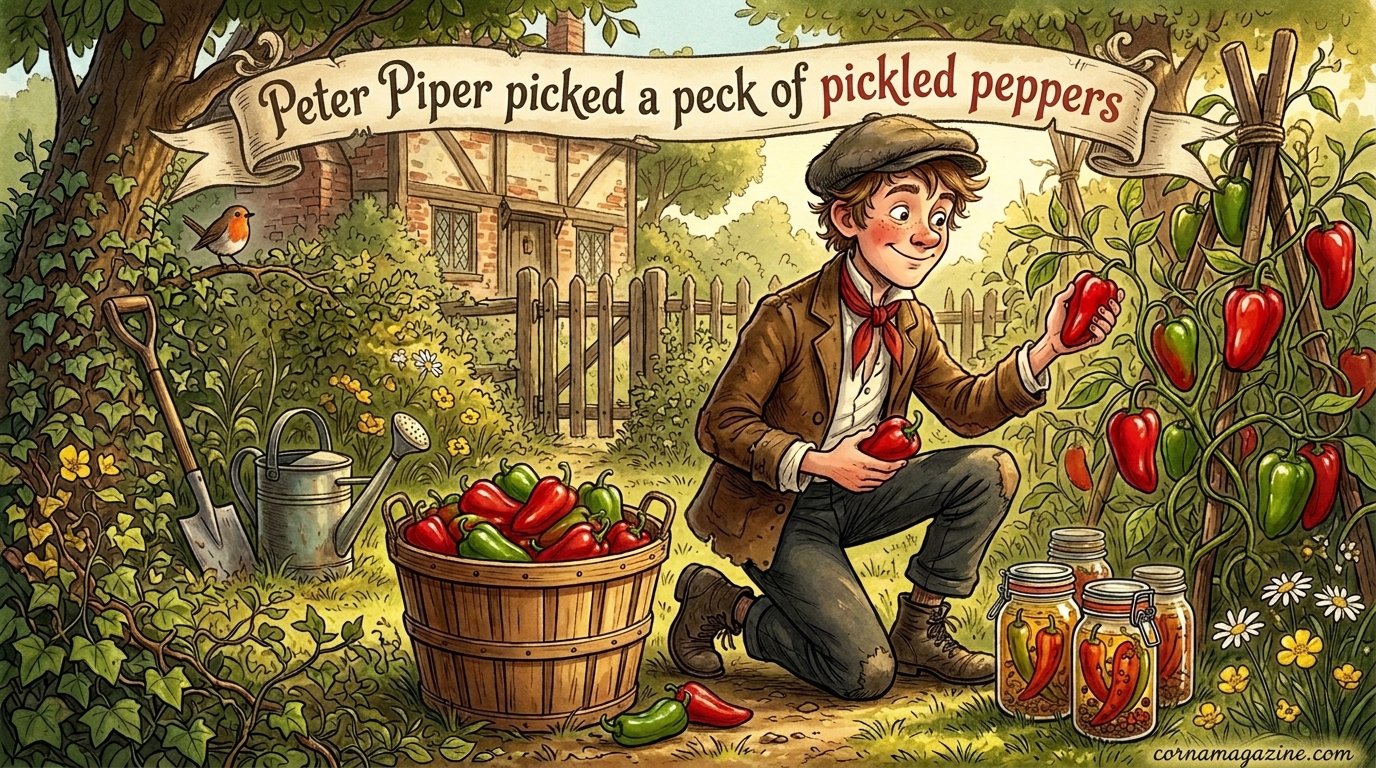
Most people know the first line of the classic tongue twister, but the full version, its history, and the everyday words that make it tricky often get left behind. This article covers the complete rhyme as it first appeared in print, explains the old measurement and the linguistic joke at its center, traces its documented origins, and notes the speculative link to a real 18th-century figure. The goal is simple: give you everything you need so the phrase makes sense and you can say it (or teach it) without confusion.
The Full Traditional Version
The earliest published form appeared in 1813. It reads:
Peter Piper picked a peck of pickled peppers,
A peck of pickled peppers Peter Piper picked;
If Peter Piper picked a peck of pickled peppers,
Where’s the peck of pickled peppers Peter Piper picked?
A shorter modern version often drops the second line and ends with a counting question:
Peter Piper picked a peck of pickled peppers.
If Peter Piper picked a peck of pickled peppers,
How many pickled peppers did Peter Piper pick
if he picked a peck of pickled peppers?
Both versions rely on rapid repetition of the “p” sound. The traditional four-line structure creates a closed loop: a statement, its reverse, a conditional, and an unanswerable question. That circular quality is part of what makes the rhyme memorable.
What the Words Actually Mean
A few terms are no longer everyday language, which is why the rhyme can feel opaque.
A peck is an old dry measure equal to one-quarter of a bushel. In imperial units that works out to roughly two gallons or eight quarts (about nine liters). So Peter was gathering a substantial amount of produce—not a small handful.
Pickled peppers are simply peppers preserved in vinegar or brine. The logical wrinkle in the rhyme is that peppers cannot be pickled until after they are harvested. The phrase therefore describes an impossibility in ordinary horticulture, which adds a quiet joke to the sound play.
The name Peter Piper itself is alliterative by design. “Piper” also happens to be the Latin root related to pepper (piper), which may help explain why the combination stuck.
History and First Publication
The tongue twister first appeared in print in London in 1813 in a children’s book titled Peter Piper’s Practical Principles of Plain and Perfect Pronunciation, published by John Harris. The book supplied one alliterative tongue twister for each letter of the alphabet; “Peter Piper” was simply the entry for P. The rest of the collection has largely been forgotten, while this single verse endured.
Evidence suggests the rhyme already existed in oral tradition at least a generation earlier. Like many nursery rhymes and speech exercises of the period, it was recorded rather than invented for the page. Its original purpose was practical: helping children practice clear pronunciation of difficult consonant clusters through repetition and speed.
The Possible Historical Inspiration
Some writers have connected the character to Pierre Poivre (1719–1786), a French horticulturist, missionary, and colonial administrator whose surname literally means “pepper.” Poivre worked in the Indian Ocean islands (notably Mauritius and the Seychelles) and is remembered for efforts to break the Dutch monopoly on valuable spices such as cloves and nutmeg by obtaining and cultivating plants outside Dutch control.
The name parallel is neat—“Peter Pepper” in English, with “piper” supplying the Latin link—and Poivre’s work with spices makes the association tempting. However, no direct documentary evidence ties the 1813 rhyme to him. The connection remains a plausible but unproven theory. The tongue twister works perfectly well as pure sound play without any biographical original.
Why the Rhyme Is Still Hard to Say
The difficulty comes from rapid alternation of similar sounds. The sequence demands repeated bilabial stops (“p”), interspersed with the “k” of “picked” and “peck” and the “l” of “pickled.” Spoken quickly, the lips and tongue have little recovery time between nearly identical motions. That is exactly what a classic tongue twister is engineered to do: expose small slips in articulation under pressure.
The structure also rewards precision. Slowing down makes every word clear; speeding up tests muscle memory and breath control. This is why the rhyme has remained useful for speech practice, voice training, and classroom games for more than two centuries.
Common Variations and Modern Uses
Beyond the two main versions already quoted, people sometimes shorten it further to a single line for quick challenges or expand it into longer performance pieces. It has appeared in songs, children’s books, and even hip-hop (notably as a reference in a 1980s track). The core remains the same: a short, rhythmic test of “p” sounds wrapped around a mild logical puzzle.
Practical Tips for Mastering It
- Start slowly and exaggerate each “p.” Feel the lip closure and release.
- Break it into pairs: “Peter Piper,” “picked a peck,” “pickled peppers.”
- Once the pairs are clean, reassemble the full lines at a walking pace.
- Only then increase speed. Accuracy first prevents the common collapse into mumbled nonsense.
- Practice in short bursts rather than long sessions so the muscles stay fresh.
These steps work for children learning enunciation and for adults who simply enjoy the challenge.
Frequently Asked Questions
Is the full rhyme only four lines?
Yes, in the traditional 1813 version. Many people know only the opening line.
How much is a peck?
Approximately two dry gallons or eight quarts—enough to fill a sizable basket.
Was Peter Piper a real person?
The character is fictional. A possible real-life namesake has been suggested, but the link is not confirmed by contemporary evidence.
Why pickled peppers specifically?
The alliteration drives the choice. “Pickled” adds an extra “p” and creates the mild absurdity that peppers cannot be pickled before they are picked.
Is it still used for speech practice?
Yes. The concentrated “p” sounds make it an efficient exercise for clarity and speed.
Closing Thoughts
“Peter Piper picked a peck of pickled peppers” endures because it is short, rhythmic, and genuinely difficult to rush. Behind the familiar first line sits a complete four-line structure first printed in 1813, an obsolete but precise unit of measure, a gentle logical joke, and a possible (but unproven) echo of an 18th-century spice trader. Once you know the full version and what the words meant in their own time, the tongue twister becomes clearer—and more fun to say.
